
The list covers 20 attractions near Eforie Nord, from those a few minutes’ walk away to those worth a whole day.
A seaside holiday doesn’t have to mean only the beach. Eforie Nord sits close to the middle of the Romanian coast, a quarter of an hour from Constanța and less than an hour from its southern end, so almost everything most interesting in Dobrogea can be seen on a day trip, getting back in time for the sunset on the seafront. Below we have gathered the sights worth the journey, grouped by distance, with what there is to see at each and how much time to set aside.
Distances are approximate and measured by road, from Eforie Nord. Museum opening hours and prices change from one season to the next, so check them before you set off.
Contents
Less than 10 kilometres away
Lake Techirghiol and the cold baths
This is not a trip but a stroll: the lake is a few hundred metres from the sea, on the other side of the resort. Its water is several times saltier than the Black Sea’s, and the mud on the bottom has been used for therapeutic purposes for over a century. On the shore, in summer, the cold baths operate: you smear yourself with mud, dry off in the sun and rinse in the lake. Everything you need to know is in the guide to Lake Techirghiol.
Time needed: a morning.
“Sfânta Maria” Monastery in Techirghiol (about 5 km)
In the town of Techirghiol, on the lakeshore, the monastery shelters an old wooden church, brought from Transylvania and placed here in 1951. The courtyard full of flowers and the quiet of the place make it one of the most visited monasteries in Dobrogea. Dress modestly, with shoulders and knees covered.
Time needed: an hour, two with the journey.
Agigea: the canal and the dunes (about 5 km)
North of Eforie, the Danube–Black Sea Canal reaches the sea. From the bridge you can see the lock and the barges waiting to pass through. Nearby is the Agigea Marine Dunes reserve, a small protected area established before the Second World War for the rare plants that grow on the sand. Access to the reserve is restricted, but its story says a lot about what the shore looked like before the resorts.
Time needed: a short stop, on the way to Constanța.
Eforie Sud
The sister resort lies beyond the sandbar between the sea and the lake. The road there, with the sea on one side and the lake on the other, is the prettiest cycling route in the area. The seafront in Eforie Sud is high, with long flights of steps down to the beach and old villas from the time when the resort was called Carmen Sylva.
Time needed: two to three hours, by bicycle.
10–20 kilometres away
Constanța: the old centre (about 15 km)
The oldest continuously inhabited city in Romania, the ancient Tomis, deserves a whole day. The Peninsula, the historic centre, is explored on foot:
- The Casino, the symbol of the city, built at the beginning of the 20th century in the Art Nouveau style, right on the seafront. It reopened to the public after a long restoration.
- Ovidiu Square, with the statue of the Latin poet exiled to Tomis, cast in bronze in the 19th century.
- The National History and Archaeology Museum, in the former town hall on the square, with the treasure of ancient sculptures found in the city.
- The Roman Mosaic Edifice, next to the museum: a large mosaic pavement from the late Roman period.
- The Carol I Mosque, with the minaret from which you can see the whole peninsula.
- The Genoese Lighthouse and the seafront promenade, as far as the Tomis tourist port, where you can eat fish.
Time needed: a day. Set off in the morning, to catch the old town before the heat.
The Dolphinarium, Planetarium and Aquarium in Constanța
These are the classic choice for families and for cloudy days. The Dolphinarium and the Planetarium are part of the same complex, in the north of the city, towards Mamaia; the Aquarium is on the Casino seafront. At the height of the season, tickets for the dolphin shows sell out quickly. More ideas for the little ones in the guide to Eforie Nord with children.
Time needed: half a day.
Tuzla: the lighthouse and the airfield (about 10 km)
South of Eforie Sud, Tuzla has one of the old lighthouses of the coast and an airfield from which pleasure flights over the coast and tandem parachute jumps are made. The wild beaches below the clay cliff are sought after by those escaping the crowds.
Time needed: two to three hours.
Costinești (about 15 km)
The youth resort is known for the wreck of a cargo ship that ran aground in the 1960s, since become the emblem of the place, and for the Obelisk. By day, the beach next to the wreck is worth a stroll; in the evening, Costinești is the noisiest resort in the south.
Time needed: an afternoon.
25–45 kilometres away
Mamaia (about 25 km)
The largest resort on the coast stretches along a long strip of sand between the sea and Lake Siutghiol. It has a cable car, a water park, beach clubs and nightlife. It is the opposite of the calm of Eforie and, precisely for that reason, a good evening outing.
Time needed: an evening or a day.
Murfatlar (about 30 km)
Inland, along the canal valley, stretch the Murfatlar vineyards, the best known in Dobrogea. The wineries in the area organise tastings, usually by appointment. Here too is the Basarabi-Murfatlar rock-cut ensemble, with little churches carved into chalk about a thousand years ago, a fragile monument that is not always open to visitors; find out before you go.
Time needed: half a day.
Mangalia (about 30 km)
The southernmost town on the coast stands on the site of the ancient Greek colony of Callatis. What to see:
- The “Callatis” Archaeology Museum and the ruins of the fortress, visible at several points in the town;
- The Esmahan Sultan Mosque, built in the 16th century, considered the oldest Muslim place of worship in Romania, with an old cemetery in the courtyard;
- the tourist port and the seafront;
- the stud farm, where thoroughbred horses are bred and you can go riding.
On the way you pass the resorts of Olimp, Neptun, Jupiter, Cap Aurora, Venus and Saturn, built in the 1960s and 1970s.
Time needed: a day.
2 Mai and Vama Veche (about 35–40 km)
The last two villages before the Bulgarian border were, for decades, the refuge of artists and students. Today they are much busier, but they keep something of that atmosphere: a wide beach, live music, fresh fish. Between them lies the Vama Veche–2 Mai Marine Reserve, Romania’s only protected marine area.
Time needed: a day or an evening.
More than 60 kilometres away
Adamclisi: Tropaeum Traiani (about 70 km)
In southern Dobrogea, in the middle of the countryside, rises the triumphal monument built by Emperor Trajan after the wars with the Dacians. What you see today is a reconstruction from the 1970s, built over the ancient core; the original metopes and statues are displayed in the museum in the village. Next to it are the ruins of the Roman city of Tropaeum Traiani. It is one of the most important history trips in Romania and is best done by car.
Time needed: half a day, with the journey.
St Andrew’s Cave (about 75 km)
Not far from Adamclisi, in a forest, is the cave where, according to tradition, the Apostle Andrew once stayed. Today it is a monastery and a place of pilgrimage. It can be combined with the visit to Adamclisi, on the same day.
Histria Fortress (about 80 km)
North of Constanța, on the shore of Lake Sinoe, lie the ruins of Histria, a Greek colony founded in the 7th century BC and regarded as the oldest urban settlement attested on the territory of Romania. The walls, the paved streets, the baths and the basilicas spread across a wind-swept promontory, with reeds and birds all around. The museum at the entrance explains what you are seeing. Take water and a hat: there is hardly any shade.
Time needed: half a day, with the journey.
The Dobrogea Gorges (about 70 km)
Also to the north, inland, the road passes between limestone rocks that were, millions of years ago, coral reefs. The landscape resembles nothing else in Dobrogea. It can be combined with Histria.
Attractions near Eforie Nord: how to organise your trips
Without a car
Constanța, Costinești, Neptun and Mangalia are easily reached by train or by the minibuses that run along the main road. Techirghiol is a short taxi ride away. How to get around, in detail, in the guide to getting to Eforie Nord.
By car
Adamclisi, Histria, Murfatlar and the Dobrogea Gorges require a car. Set off early: in Dobrogea, in summer, midday is very hot, and the archaeological sites have no shade.
Three combinations that work well
- The ancient day: Adamclisi in the morning, St Andrew’s Cave at lunchtime, return via Murfatlar.
- The northern day: Histria in the morning, the Dobrogea Gorges, then the evening in Mamaia or in the Tomis port.
- The southern day: Mangalia in the morning, the beach at 2 Mai, sunset and dinner in Vama Veche.
And one attraction you don’t have to go anywhere for
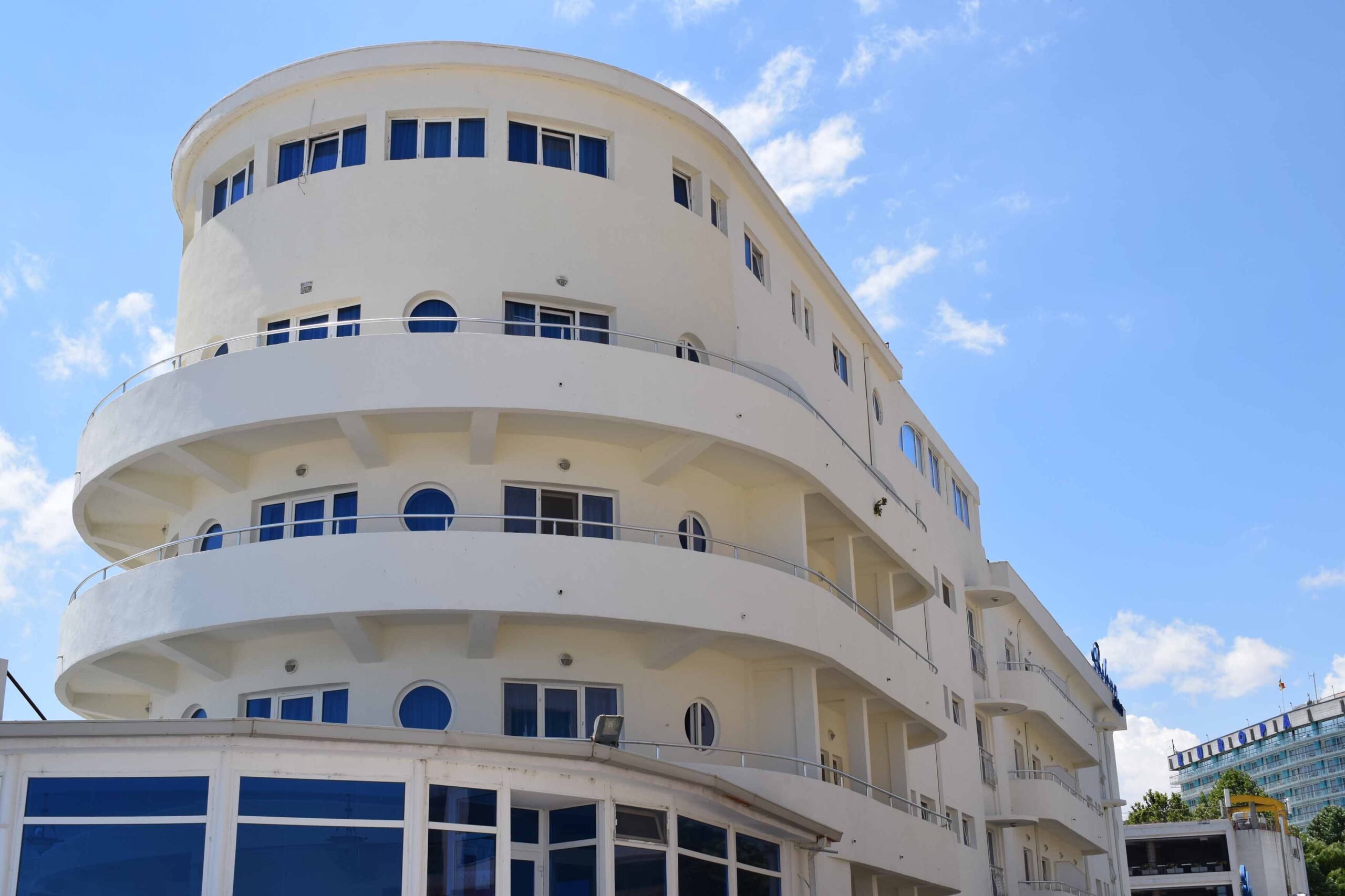
One of the historic monuments of national value on the coast is right on the seafront in Eforie Nord. Hotel Belona, the ship-shaped building designed by the architect George Matei Cantacuzino and inaugurated in 1933, is listed as a Grade A historic monument on the List of Historic Monuments. Its story, year by year, is on the History of the Place page, and the context in the article on the modernist architecture of the coast.
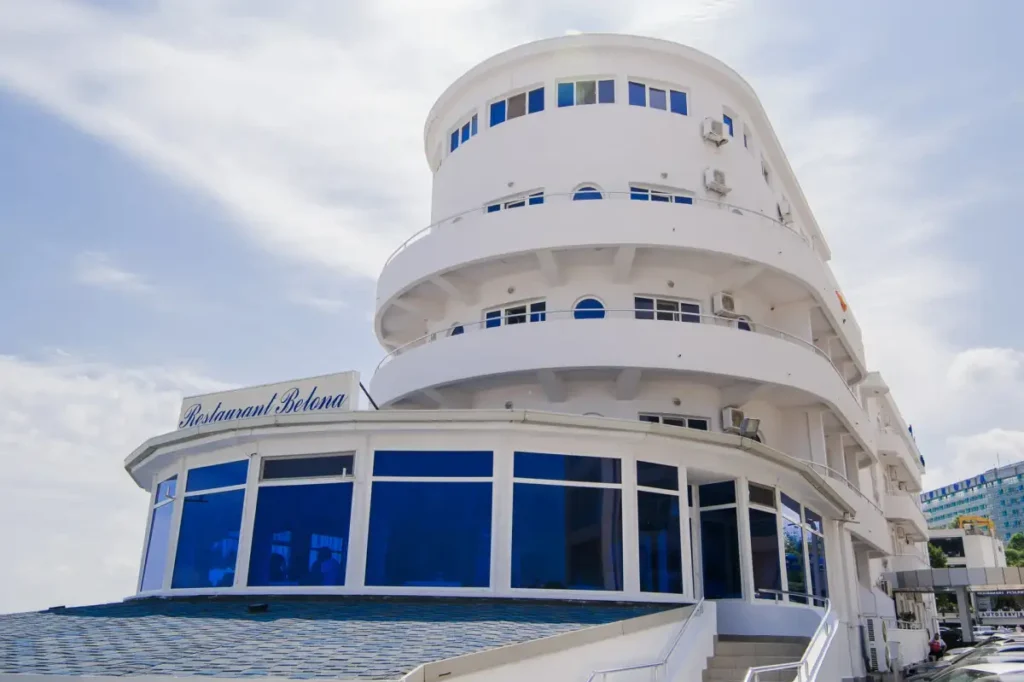
If you want to stay right in it, bookings are made on +40 21 555 25 70 or at belona@avenuehotels.ro. Breakfast is included and parking is free, subject to availability, which is useful if you make trips by car.
Little-known sights, for those who have already seen everything
Capidava (about 100 km)
On the bank of the Danube, north of Cernavodă, the ruins of a Roman fort have guarded a bend of the river for almost two thousand years. The view from the walls, with the wide Danube below, is one of the most beautiful in Dobrogea.
Lake Sinoe and the fishing villages
Beyond Histria begins the world of the lagoons: shallow water, reeds, pelicans and Lipovan villages where you eat fresh fish. It is the southern edge of the Danube Delta Biosphere Reserve.
Limanu
South of Mangalia, the village of Limanu is known for a long, labyrinthine cave, the longest in Dobrogea. Visiting it is not open to all, but the lake and the small boat harbour are worth a detour.
The wild beaches between Tuzla and Costinești
Below the clay cliffs between the two localities stretch beaches with no sunbeds and no terraces. You get there by dirt roads, with care after rain. They have no lifeguards, so swim with the utmost caution.
Practical tips for trips
- Set off early. In summer, in Dobrogea, it is very hot between 12 and 16, and the archaeological sites have no shade.
- Take water and a hat for everyone, plus a snack. At Histria and Adamclisi there aren’t many shops.
- Check the opening hours. Many museums are closed on Mondays, and some monuments can only be visited by appointment.
- Closed footwear for ruins, where you walk on stone and through dry grass.
- Modest dress for monasteries and mosques: shoulders and knees covered. At a mosque, shoes are left at the entrance.
- Cash, for tickets and for car parks where you can’t pay by card.
- Come back before 18:00 or after 21:00, to avoid the traffic on the road between Constanța and the southern resorts.
How much time is left for the beach
A good rule: one trip for every two or three beach days. In a week-long stay there is easily room for a day in Constanța, half a day at Techirghiol and a longer trip, to Adamclisi or Histria. The rest is left for the sea, the seafront and the morning coffee on the terrace. We have gathered what you can do without leaving the resort in the guide to what to do in Eforie Nord.
Frequently asked questions
What can you visit near Eforie Nord in a single day?
The old centre of Constanța, with the Casino, Ovidiu Square and the Roman Mosaic Edifice, is the best choice for a single day: it is about 15 kilometres away and can be covered on foot.
How far is Constanța from Eforie Nord?
About 15 kilometres, which is 20–30 minutes by car, minibus or train.
Is the trip to Adamclisi worth it?
Yes, if you are interested in history. The monument and the museum can be seen in two to three hours, and the drive through southern Dobrogea is beautiful, especially in spring and early summer.
Which attractions are suitable for children?
The Dolphinarium, the Planetarium and the Aquarium in Constanța, the wreck at Costinești, the airfield at Tuzla and the stud farm in Mangalia.
Can you get to Histria without a car?
It is difficult. Public transport to the fortress is infrequent, so the most practical solution remains a car or an organised trip from Constanța.
What is the nearest attraction to Eforie Nord?
Lake Techirghiol, with its cold mud baths, a few minutes’ walk away, and the monastery in Techirghiol, about 5 kilometres away.
The period photographs on this site come, for the most part, from the Andrei Ștomff Collection of the National Institute of Heritage and from the Fortepan archive; the source and licence of each image are given in its caption.