
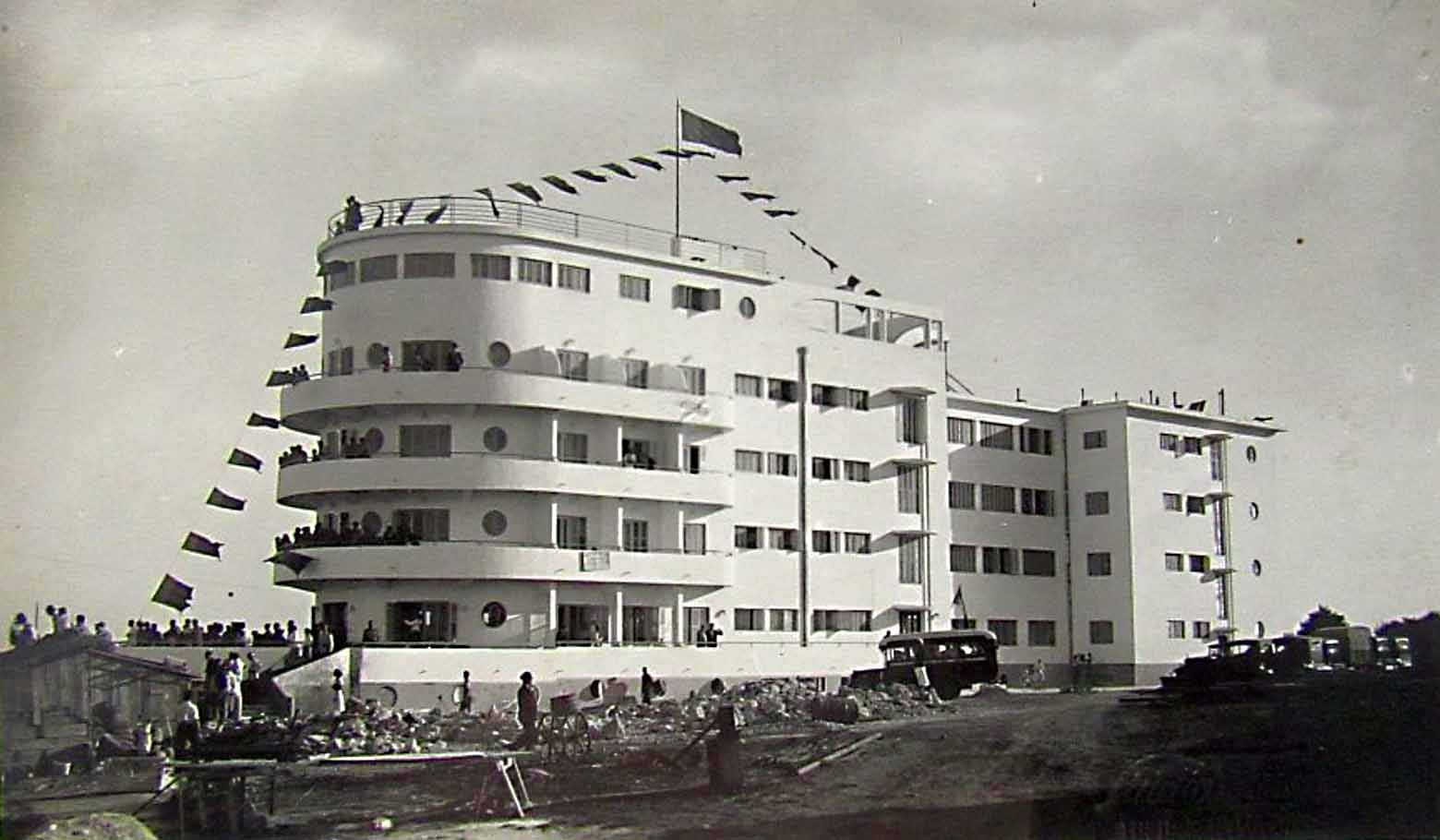
The Romanian coast is usually associated with the big hotels of the 1960s and 1970s. Less well known is that, before them, between the two world wars, one of the boldest architectures in Romania was built on the same shore. At Eforie, an entire seafront was drawn in a few years by young architects who believed that a house by the sea should be white, simple, full of sunlight and open to the water. The best known of their buildings is a hotel shaped like a ship. This article explains what modernist architecture is, why it suited the sea so well, who the architects of Eforie were, and how to recognise their buildings today on a walk along the seafront.
Contents
What modernist architecture is, in plain terms
Modernism appeared in Europe after the First World War, as a break with historical styles. Its architects gave up columns, plaster ornaments and complicated roofs, and started from a simple question: what is the building for, and how do people live in it? Their answer has a few features that are easy to recognise:
- Simple, geometric volumes, with no applied decoration.
- White facades or facades in light colours.
- A roof terrace, where you can sit in the sun.
- Wide windows, often in horizontal bands, which bring light into the whole room.
- Generous balconies and terraces, as extensions of the rooms.
- Reinforced concrete, the material that makes cantilevers, rounded corners and open plans possible.
The idea behind them was also one of health. The doctors of the time recommended sun, clean air and hygiene, and architects responded with bright, airy houses that were easy to clean. It is no accident that many of the first modernist buildings were sanatoriums.
Why it looks like ships
In the 1920s, ocean liners were the most admired machines in the world. Modernist architects held them up as an example: a ship has nothing superfluous, every one of its forms has a purpose, and yet it is beautiful. Tubular railings, portholes, stacked decks and funnels thus entered the vocabulary of architecture.
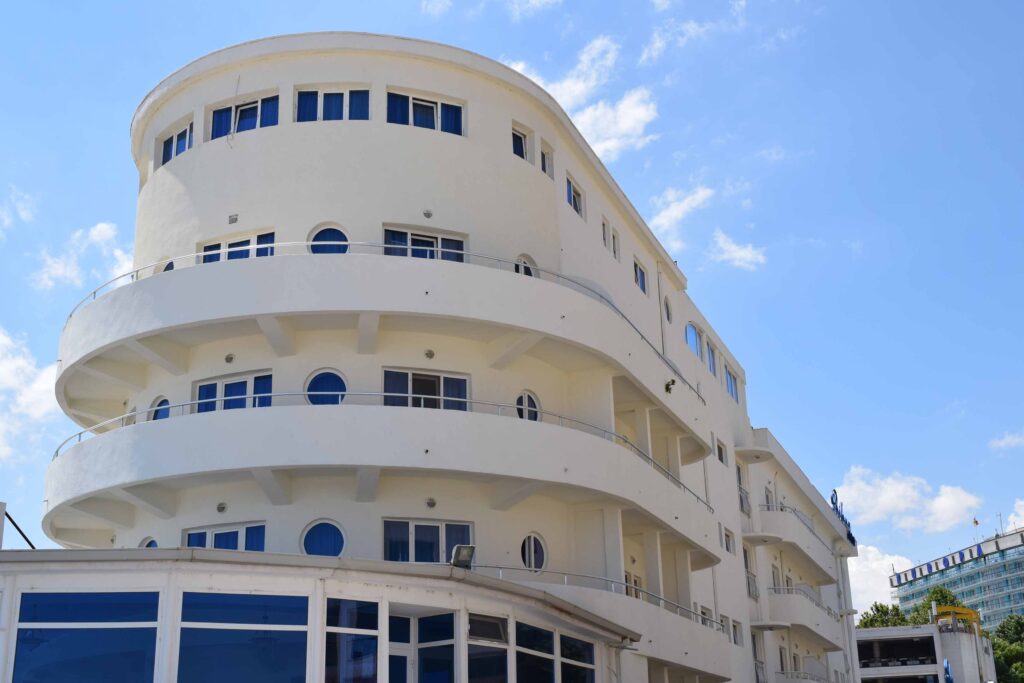
The current that took this resemblance furthest is sometimes called the “ocean-liner style (paquebot)”, after the French word for a passenger ship. Its buildings have rounded corners, round windows, curved balconies like decks, and long horizontal lines that give an impression of movement. By the sea, where real ships can be seen on the horizon, the style found its natural home.
Eforia in the 1930s: a seafront drawn from scratch
Eforia had existed since 1899, when Eforia Spitalelor Civile (the board of Bucharest’s civil hospitals) opened its seaside sanatorium here. The seafront facing the sea, however, remained almost empty for a long time. The land belonged to the banker Aristide Blank, who, between 1930 and 1934, divided it into plots according to a plan by the architect George Matei Cantacuzino.
It is a rare case: an architect is given a whole stretch of shore and thinks of it as a single whole, with streets, plots and a promenade. On the plots, three of the most important Romanian architects of their generation then built for clients from Bucharest’s high society: Cantacuzino, Horia Creangă and Henrieta Delavrancea-Gibory.
The specialist press abroad noticed immediately. In 1934, the Paris magazine L’Architecture d’aujourd’hui published the photograph and plan of the new hotel at Eforie and noted that here a single architect had been able to build an entire beach: a few villas and a hotel.

The architects of the seafront
George Matei Cantacuzino (1899–1960)
Born in Vienna into an old boyar family and trained at the School of Fine Arts in Paris, Cantacuzino was an architect, painter, teacher and one of the finest essayists of Romanian culture. He worked on the restoration of Mogoșoaia Palace, designed the Chrissoveloni Bank Palace in Bucharest and, on the coast, Hotel Rex in Mamaia and Hotel Bellona in Eforie. He founded the magazine Simetria and wrote books on architecture that are still read today.
He was not a dogmatic modernist. He came from the classical tradition and believed in proportion, measure and balance, which he kept even in his newest buildings. After the communist regime was established, he was imprisoned between 1948 and 1954. He died in 1960, in Iași.
Horia Creangă (1892–1943)
A nephew of the writer Ion Creangă, he is considered the main representative of Romanian modernism. The ARO Block on Magheru Boulevard in Bucharest, completed in the early 1930s, changed the look of the capital’s centre. At Eforie he designed villas, in the same sober and clear language.
Henrieta Delavrancea-Gibory (1894–1987)
The daughter of the writer Barbu Ștefănescu Delavrancea and one of the first women architects in Romania. She is best known for the villas at Balchik, in which she combined modernism with the local architecture of the shore. She also worked at Eforie, in the years when the seafront was being built.
Hotel Bellona: the manifesto building
At the southern end of the seafront, Cantacuzino received the commission for a seaside sanatorium for the Society of Disabled War Veterans. The foundation stone was laid on 22 October 1932, and the inauguration took place in August 1933. From 1934, the building operated as a hotel.
A few things make it distinctive:
- The siting. The building stands perpendicular to the shore, not parallel to it. The rooms thus face south and east, get sun in the morning and light all day, and the balconies open towards the sea on both sides. For a sanatorium, where the sun was a treatment, the choice also had a medical purpose.
- The prow. The end facing the sea is rounded, and the balconies wrap around it floor by floor, like the decks of a ship.
- The terrace. At the base, a wide terrace extends towards the seafront, above the beach. A 1937 newspaper called it the “prow” that goes straight into the sea.
- The round windows. A few portholes punctuate the facade, exactly where the eye expects them.
- The whiteness. Against the summer sky and sea, the building can be seen from far away, like a ship at anchor.
In July 1937 the press described it as a huge four-storey ship, and in August 1938 Neamul Românesc wrote about “the Bellona hotel with its specifically marine architecture”. Today, Hotel Belona is a Grade A historic monument, the category of monuments of national value, with the code CT-II-m-A-02880. I told the same story briefly in the article why it is called “the ship on the seafront”, and at length, with photographs, on the page The history of the place.

Other places on the coast where you can see interwar modernism
- Mamaia. Hotel Rex, also designed by Cantacuzino in the second half of the 1930s, is the most imposing interwar hotel on the Romanian coast.
- Eforie Sud. The former resort of Carmen Sylva keeps villas from the same period, on the high cliff.
- Constanța. Besides the Art Nouveau Casino, the city has modernist apartment blocks and villas from the 1930s, especially in the area of the peninsula and the central boulevards.
- Balchik. Today in Bulgaria, the town where Queen Marie made her summer residence was, in the 1930s, the other great building site of Romanian architects by the sea. The villas there by Henrieta Delavrancea-Gibory are famous.
What came next: the second modernism
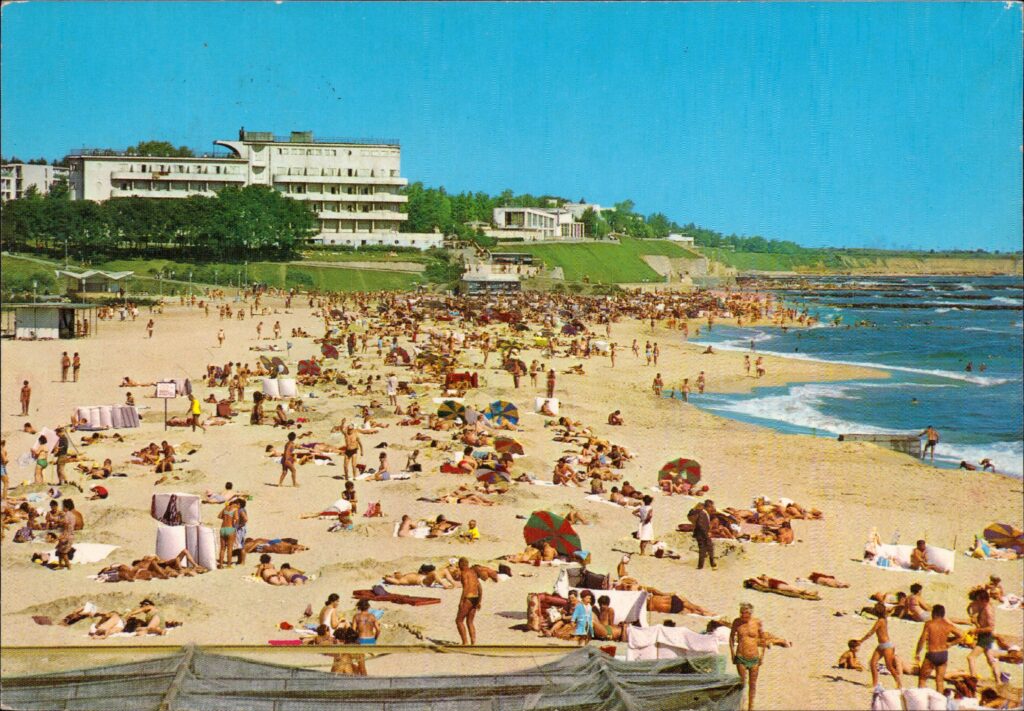
After the war and nationalisation, the villas on the seafront became rest houses. In the first years of the communist regime, official architecture was that of socialist realism, with columns and pediments. But from the second half of the 1950s, the coast became a laboratory again: a new generation of architects, led by Cezar Lăzărescu, built hotels and restaurants with clean lines, terraces and glass walls at Eforie, Mangalia and Mamaia, taking up again, in different conditions, the lesson of the 1930s.
Postcards show the two eras side by side: the white ship of 1933 in the foreground, and the new hotels rising behind it.
How to recognise a modernist building on the seafront
On a walk along the seafront in Eforie Nord, look for:
- The flat roof. If you see no tiles, you are on the right track.
- Rounded corners. Especially on balconies and stairwells.
- The round window. The porthole is the signature of the era.
- Tubular railings, horizontal, as on a deck.
- Wide windows, sometimes turning round the corner.
- The absence of ornament. The beauty comes from proportions, not from decoration.
Many of the old villas have been altered over time: enclosed terraces, added storeys, replaced joinery. With a little practice, though, the original form can still be guessed under the additions.
Why it matters
The architecture of the 1930s at Eforie is not merely beautiful. It is proof that a resort can be conceived as a whole, on a human scale: low buildings, oriented towards the sun, with terraces facing the sea and a shared promenade. It is also a fragile heritage. The National Institute of Heritage documented it in 2022, in the project “Boemă și Loisir”, precisely because many of these buildings are little known and some are in poor condition.
Every visitor who raises their eyes to a round window and wonders who drew it is doing something to preserve them. The wider history of the place is in the article the history of the resort of Eforie Nord.
Sleeping in a monument
Few architectural monuments can be lived in, even for a few nights. Hotel Belona is one of them. The rooms keep the logic of the 1933 plan: they face south and east, and those at the rounded end have curved walls, with windows across their full width. In the morning, the sun comes in exactly as the architect intended.
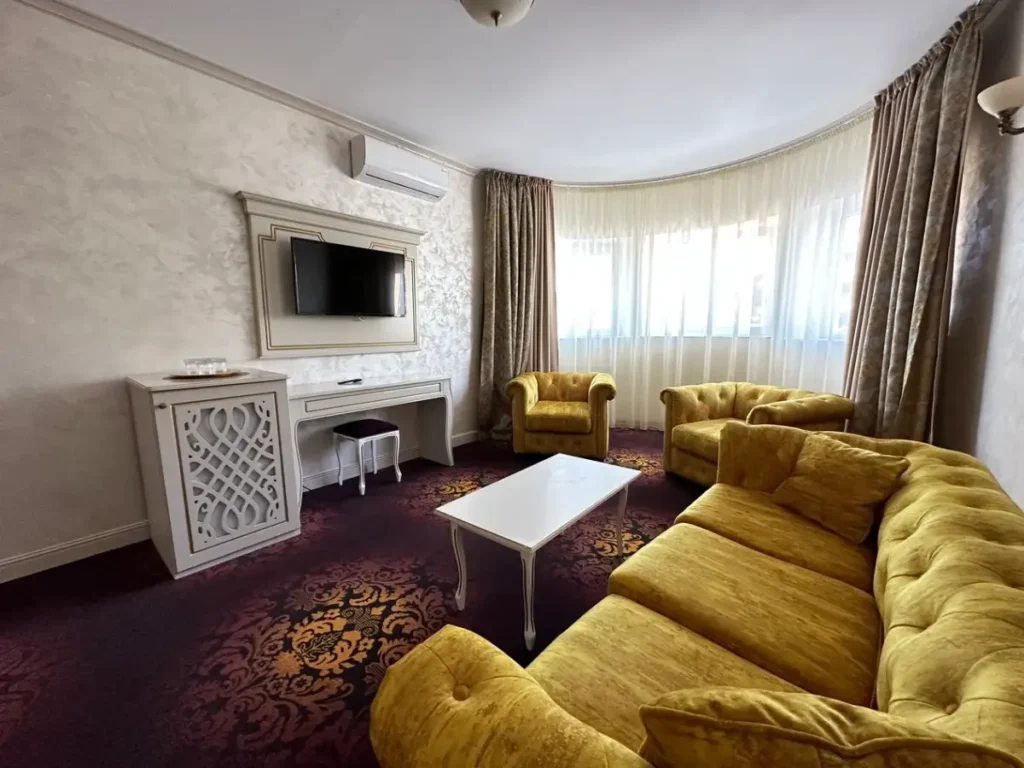
Breakfast is included, the beach is two to three minutes away, down the steps, and the hotel’s café bar opens on the terrace above the beach. Reservations on +40 21 555 25 70 or at belona@avenuehotels.ro.
The sanatorium, the modernists’ favourite building
It is no accident that the ship on the seafront was originally a sanatorium. Between the two wars, the sanatorium was the brief on which modern architects put their ideas to the test. The medicine of the time treated many illnesses with sun, clean air and rest, and a well-conceived building was part of the treatment: rooms facing the sun, long terraces where patients could lie outdoors, smooth surfaces that were easy to wash, and large windows that opened wide.
All these requirements can be found at Bellona. The rooms face south and east. The balconies are deep and continuous, wide enough for a deckchair. The plan is simple, with one corridor and rooms on both sides of it. When the building became a hotel, in 1934, almost nothing had to be changed: what was good for a convalescent proved just as good for a person on holiday. I wrote about the link between the resort and treatment in the Lake Techirghiol guide.
A short glossary for your walk along the seafront
- Roof terrace: a flat, walkable roof, used as a place to sit in the sun.
- Cantilever: a part of the building that projects outwards without columns underneath, like long balconies.
- Ribbon window: a horizontal row of windows that lights the room evenly.
- Porthole: a round window, borrowed from ships.
- Pilotis: columns that lift a building off the ground, leaving the ground floor open.
- Open plan: an interior in which the walls no longer support the building and can be placed anywhere.
- Ocean-liner style (paquebot): modernism inspired by passenger ships, with rounded forms and horizontal lines.
- Division into plots: the splitting of a large piece of land into plots, with streets and building rules.
Where to read more
For those who want to go further, a few serious sources: the studies by the architect Ruxandra Nemțeanu on Cantacuzino and seaside holidaymaking, published in the magazine Arhitectura; the project “Boemă și Loisir” of the National Institute of Heritage, from 2022, which photographed and described the interwar buildings of the coast; and the essays of George Matei Cantacuzino himself, reissued in recent decades, in which the architect explains, clearly and with humour, his way of thinking about a house.
Frequently asked questions
Who designed Hotel Belona in Eforie Nord?
The architect George Matei Cantacuzino. The building was begun in October 1932 and inaugurated in August 1933.
What architectural style is Hotel Belona?
Modernist, with features of the so-called ocean-liner style (paquebot): a rounded end like a prow, curved balconies, round windows and white facades.
Is Hotel Belona a historic monument?
Yes. It is a Grade A historic monument, entered in the List of Historic Monuments under the code CT-II-m-A-02880.
What is the ocean-liner style (paquebot)?
A variant of 1930s modernism inspired by passenger ships: rounded corners, portholes, tubular railings and long horizontal lines.
What other buildings did George Matei Cantacuzino design?
Among the best known are the Chrissoveloni Bank Palace in Bucharest and Hotel Rex in Mamaia. He also worked on the restoration of Mogoșoaia Palace.
Where else can I see modernist architecture on the coast?
In Mamaia (Hotel Rex), in Eforie Sud, in Constanța and, across the border, in Balchik.
Can you visit Hotel Belona?
The building operates as a hotel, so the simplest way to see it from the inside is to stay there. The exterior, the terrace and the prow can be seen very well from the seafront and from the beach.
The vintage photographs on this site come, for the most part, from the Andrei Ștomff Collection of the National Institute of Heritage and from the Fortepan archive; the source and licence of each image are given in its caption.