
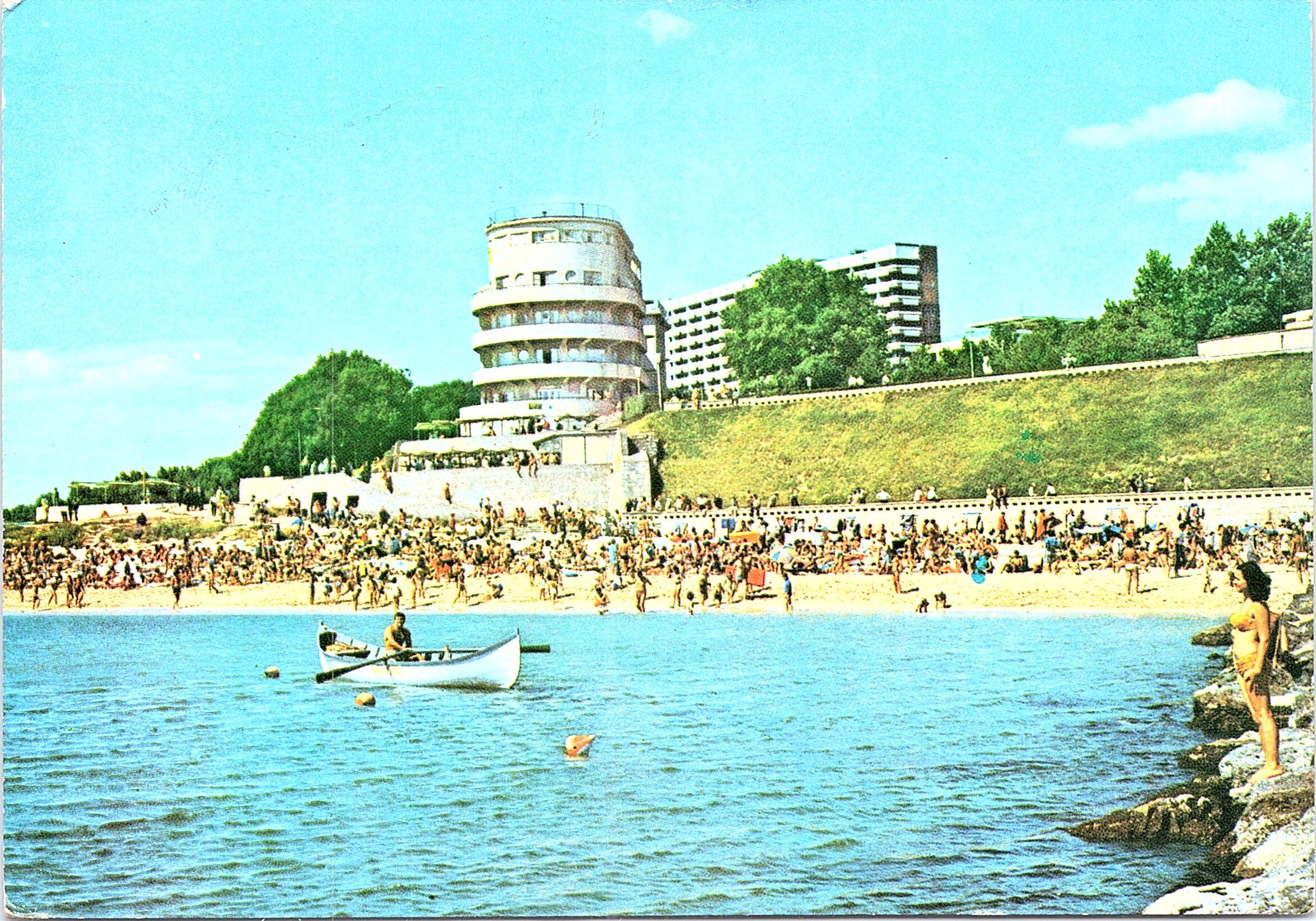
Belona beach is one of the best-known beaches in Eforie Nord and, for many of those who come back year after year, the only one they go to. It lies at the southern end of the seafront, beneath the white ship-shaped building that gave it its name. In this guide you will find exactly where it is, how to get there, what the water and the sand are like, who it suits and what to watch out for, plus a few things you will not learn from photographs.
Contents
Where Belona beach is
The beach stretches along the foot of the high cliff in the south of the resort of Eforie Nord, opposite Hotel Belona, on Tudor Vladimirescu Street. If you are coming from the centre of the resort, you find it by walking south along the seafront, to the end of the promenade. From up on the seafront you can see the whole bay: the sand, the breakwaters that enclose it and, beyond them, the open sea.
You go down by steps. There are several flights of stairs along the cliff, and the ones opposite the hotel lead straight onto the sand. From the hotel door to the water it is two to three minutes on foot.

Where its name comes from
The beach took the name of the hotel, not the other way round. The building was inaugurated in August 1933 as a seaside sanatorium of the Society of Disabled War Veterans, and was named after Bellona, the Roman goddess of war, protector of those wounded in battle. From 1934 it operated as a hotel. In the 1950s the name disappeared from postcards, only to return towards the end of the 1960s, this time with a single l.
By then, people had already begun to name the beach beneath it after the hotel as well. A postcard sent in 1978 bears the very title “Eforie Nord. Plaja Belona”. We have told the whole journey of the name in the article Bellona, with a double l.
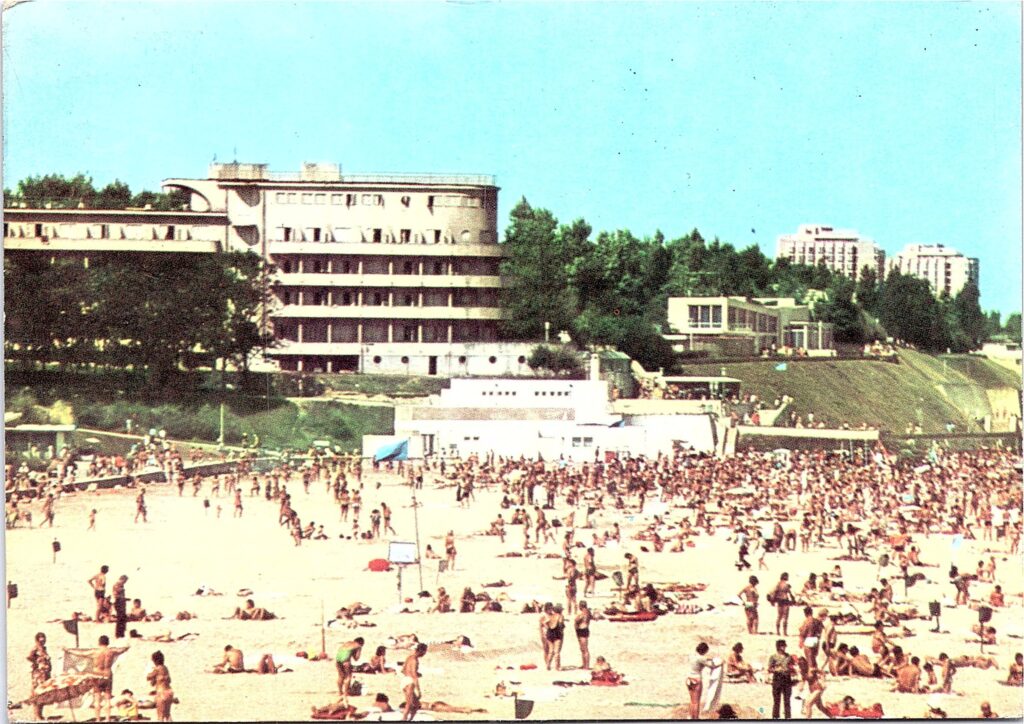
What it looks like: sand, water, breakwaters
The sand
The sand is fine and light in colour, mixed in places with tiny shells, as everywhere on the Romanian coast. Between 2020 and 2021 the beaches in Eforie Nord were widened with imported sand, so the strip of sand is much wider today than in the old photographs.
The water
The bay is protected by stone breakwaters, which break the waves coming in from open water. On ordinary summer days, the water between the breakwaters is calmer than on the open beaches, and the entry is gentle. After storms, seaweed and shells can collect at the water’s edge; they usually disappear within a day or two.
The seafront
Above the beach rises the seafront, with its promenade and the silhouette of the hotel. In the late afternoon, the cliff casts its shadow over the landward part of the beach, which is precious in July and August. Those who want sun until evening settle closer to the water.
Who it suits
- Families with small children: the sheltered water and the gentle entry are the main reason parents choose it. Children should still never be left unsupervised for a moment, however calm the sea may look.
- Those who are not very strong swimmers: the area between the breakwaters is friendlier than the open sea. Stay within the area watched by the lifeguards.
- Those looking for quiet: being at the end of the resort, the beach is usually less crowded than those in the centre, especially in the morning and outside weekends.
- Photography enthusiasts: the sunrise, with the sun coming out of the sea, and the white prow of the hotel lit by the first light are two of the most photographed images in Eforie.
What to watch out for
The lifeguards’ flags
The rule is the same along the whole coast: green flag, swimming allowed; yellow flag, caution; red flag, going into the water forbidden. Respect it even when the sea looks calm, because the danger comes from currents, not from waves.
The breakwaters
The stone breakwaters are slippery and are not made for walking or jumping. Currents that pull out to open water form near them. Swim at a distance from them and do not let children climb on the boulders.
The sun
Between 12:00 and 16:00, in July and August, the sun is very strong. High-factor sun cream, a hat, plenty of water and a break in the shade during the peak hours are essential, especially for children.
Jellyfish and seaweed
They appear from time to time, depending on the currents and the water temperature. The usual Black Sea jellyfish are generally harmless or cause only slight irritation, but it is better to steer clear of them. Seaweed brought in by the waves is unpleasant, not dangerous.
How to get to Belona beach
- On foot, from the centre of the resort: along the seafront, heading south, to the end of the promenade. The walk is pleasant and almost entirely at height, with a view of the sea.
- By car: the reference address is 9 Tudor Vladimirescu Street, Hotel Belona. In high season, parking spaces in the seafront area fill up early; hotel guests have free parking, subject to available spaces.
- By train: Eforie Nord station is in town. From there, you reach the seafront on foot or by taxi.
If you are coming from another part of the country, all the options are explained in the guide how to get to Eforie Nord.
A day on Belona beach, hour by hour
5:30–8:00: sunrise and the empty beach
Those who wake early get the loveliest hour of the day. The sand is smooth, the water clear, and the light falls straight onto the white façade of the hotel. It is also the best hour for a run along the seafront or for a short, invigorating swim.
8:00–11:30: the beach with the children
After breakfast, the sun is still gentle. It is the ideal interval for children: sandcastles, paddling at the water’s edge, shells. Towards 11:00 the beach begins to fill up.
12:00–16:00: the break
The peak hours are for shade. Lunch, an afternoon nap, a book in your room or a walk to the lake, where the wind blows differently. If you are staying on the seafront, your room is two minutes away, so you do not have to carry anything.
16:30–19:30: the second swim
In the afternoon the water is at its warmest of the day, and the light turns golden. The cliff begins to cast shade on the sand. Many locals say this is, in fact, the best part of the beach day.
After 20:00: the seafront
In the evening you climb the steps, shake out the sand and go out for a stroll. From above, the whole bay can be seen, with the lights of the resort coming on one by one.
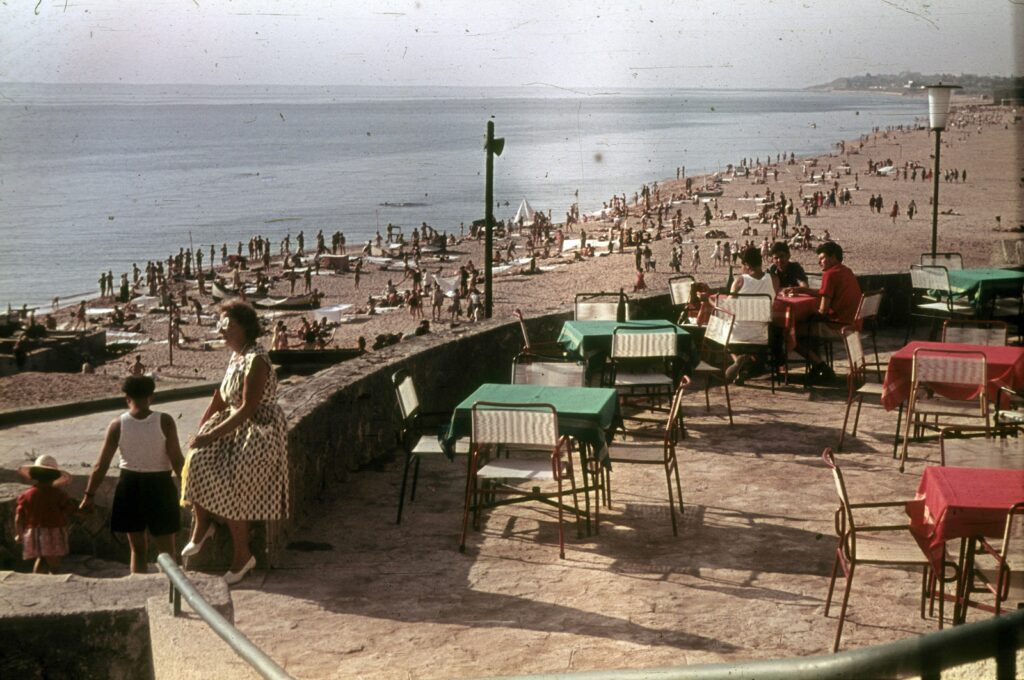
Belona beach, 60 years ago
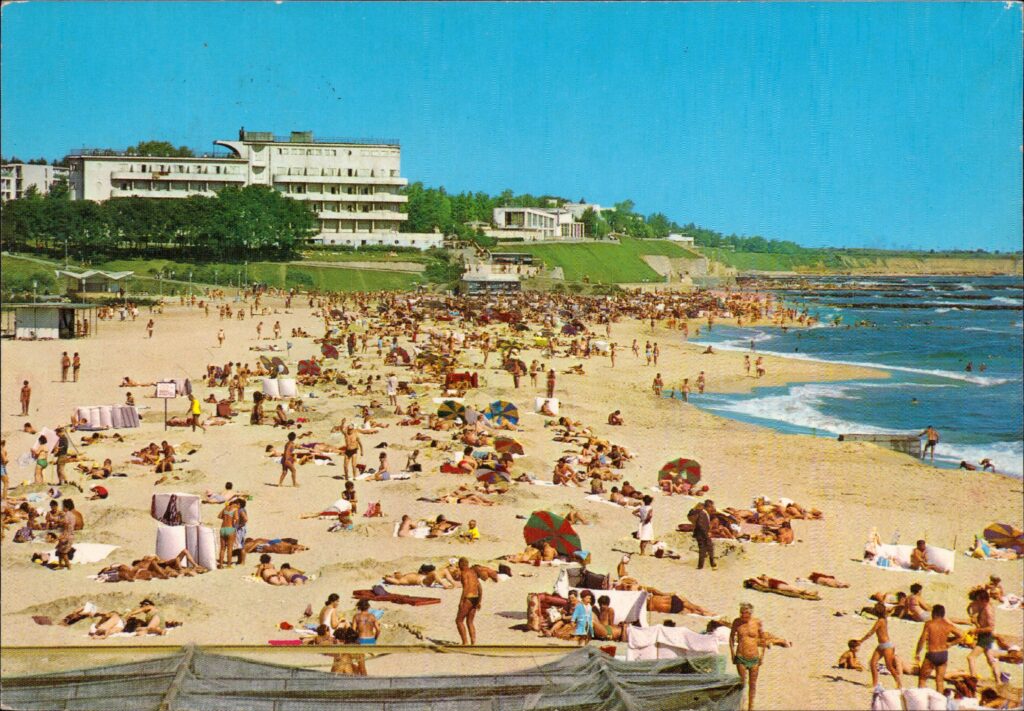
The old photographs show the same beach, just as full. A colour slide from 1960 shows the hotel terrace, with tables covered in red and green tablecloths, and below it the sand covered in people, and the sea. Postcards from the 1970s show colourful parasols, children at the water’s edge and, always in the corner of the picture, the white prow on the seafront.
The swimsuits and the hotels in the background have changed. The bay, the breakwaters and the steps that lead down from the seafront are the same. All these images, put in order of year, are on the page The history of the place.
What else is nearby
- The seafront: it begins right above the beach and leads to the centre of the resort.
- Lake Techirghiol: on the other side of the resort, with the cold mud baths. See the Lake Techirghiol guide.
- The road to Eforie Sud: on the spit of land between the sea and the lake, good for cycling and running.
- The café bar on the hotel terrace: for a coffee with a view of the bay, before or after the beach.
Where to stay near Belona beach
Closest to the beach is Hotel Belona itself, which stands above it, on the seafront. A few things to know:
- the beach is two to three minutes on foot, by the steps;
- breakfast is included and is served as a buffet;
- the building has a lift, and the rooms face south and east, towards the sea;
- parking is free, subject to available spaces;
- check-in is from 18:00, and rooms must be vacated by 12:00.
Bookings are made by phone, on +40 21 555 25 70, or by e-mail, at belona@avenuehotels.ro.
What to put in your beach bag
- high-factor sun cream and an after-sun lotion;
- a hat or cap, sunglasses;
- water, more than you think you need;
- a large towel and a small one, for wiping the sand off your feet;
- water shoes, for the shells at the water’s edge;
- a thin jumper, for the evening wind;
- a rubbish bag: nothing gets left behind on the beach.
On a towel or on a sunlounger?
As on all the beaches along the coast, here too part of the sand is laid out with sunloungers and parasols, hired by the day, while part is left free, for those who come with their own towel and parasol. If you choose a sunlounger, come before 10:00 in high season to get a spot close to the water, and ask from the start about the rate and what it includes. If you choose the towel, a beach parasol with a sand screw is the best investment of the holiday: the afternoon breeze snatches up parasols that are planted at random. In both cases, do not leave valuables unattended when you go into the water; take only the bare essentials to the beach.
Belona beach through the year
The beach does not look the same every month, and that is worth knowing when you choose your time.
June
The sand is clean, freshly levelled after winter, and there are few people. The water warms up from one week to the next: cool at the start of the month, good for swimming towards the end. It is the month of those who read on the beach.
July and August
Full season. The water is warm, all the sunloungers are out, and after 11:00 the beach fills up. Early morning and late afternoon remain quiet even now. Around 15 August is the busiest moment of the year.
September
The light turns golden, the shadows lengthen and the water keeps the warmth of summer. In the first half of the month you can swim without any problem. The beach is almost empty during the week.
Late autumn and winter
Without sunloungers and parasols, the bay can be seen as it is: an arc of sand between the breakwaters, with the seafront above. The winter sea, with waves breaking on the stones, is a spectacle for those who come dressed warmly. We compared the months at length in the article when to go to the seaside in Eforie Nord.
Common-sense rules on the beach
- Do not leave rubbish. Cigarette butts and plastic lids end up in the sea at the first storm.
- Do not feed the seagulls. They learn to steal food from children’s hands.
- Keep music in your headphones. The people on the next towel came for the sound of the waves.
- Do not take sand and shells away by the sackful. A few shells as a souvenir are enough; the beach needs the rest.
- Respect the marked zones for towels, for sunloungers and for boats.
- Do not go into the water after drinking alcohol. Most accidents on the coast happen this way.
Good photographs on Belona beach
If you want to leave with a successful picture, there are three places and three times to remember. At sunrise, from the sand, with the sun coming out of the sea between the breakwaters. In the first hour of the morning, from the foot of the steps, with the white prow of the hotel lit from the front, exactly the angle of the postcard sent in 1958. And in the evening, from above, from the seafront, when the whole bay can be seen and the lights of the resort come on. Avoid midday: the light is harsh, and the shadows are short.
Frequently asked questions about Belona beach
Is Belona beach suitable for children?
Yes, it is one of the beaches in Eforie Nord that families often choose, because the bay is protected by breakwaters and the entry into the water is gentle. Children must nevertheless be supervised all the time, and swimming should only be in the area guarded by lifeguards.
Do you pay to enter the beach?
No. Beaches on the Romanian coast are public, and access is free. You pay only for hired sunloungers and parasols; on the sections reserved for towels you can sit for free.
How far is it from the centre of the resort?
The beach is at the southern end of the seafront. From the centre you get there on foot, along the seafront promenade, in an easy walk.
Is the water deep?
Near the shore the water is shallow and the bottom slopes gently. The depth increases towards the breakwaters and beyond them. The level of the sand changes from year to year, so always go in slowly and look at the lifeguards’ indications.
When is it least crowded?
Early in the morning, on weekdays, and in June and September. At weekends in July and August the beach fills up after 11:00.
Why is it called Belona?
After the hotel above it, inaugurated in 1933 under the name of the Roman goddess Bellona. The hotel’s name has been spelled with a single l since the 1960s, and the beach took it over in the same form.
The period photographs on this site come, for the most part, from the Andrei Ștomff Collection of the National Institute of Heritage and from the Fortepan archive; the source and licence of each image are given in its caption.