
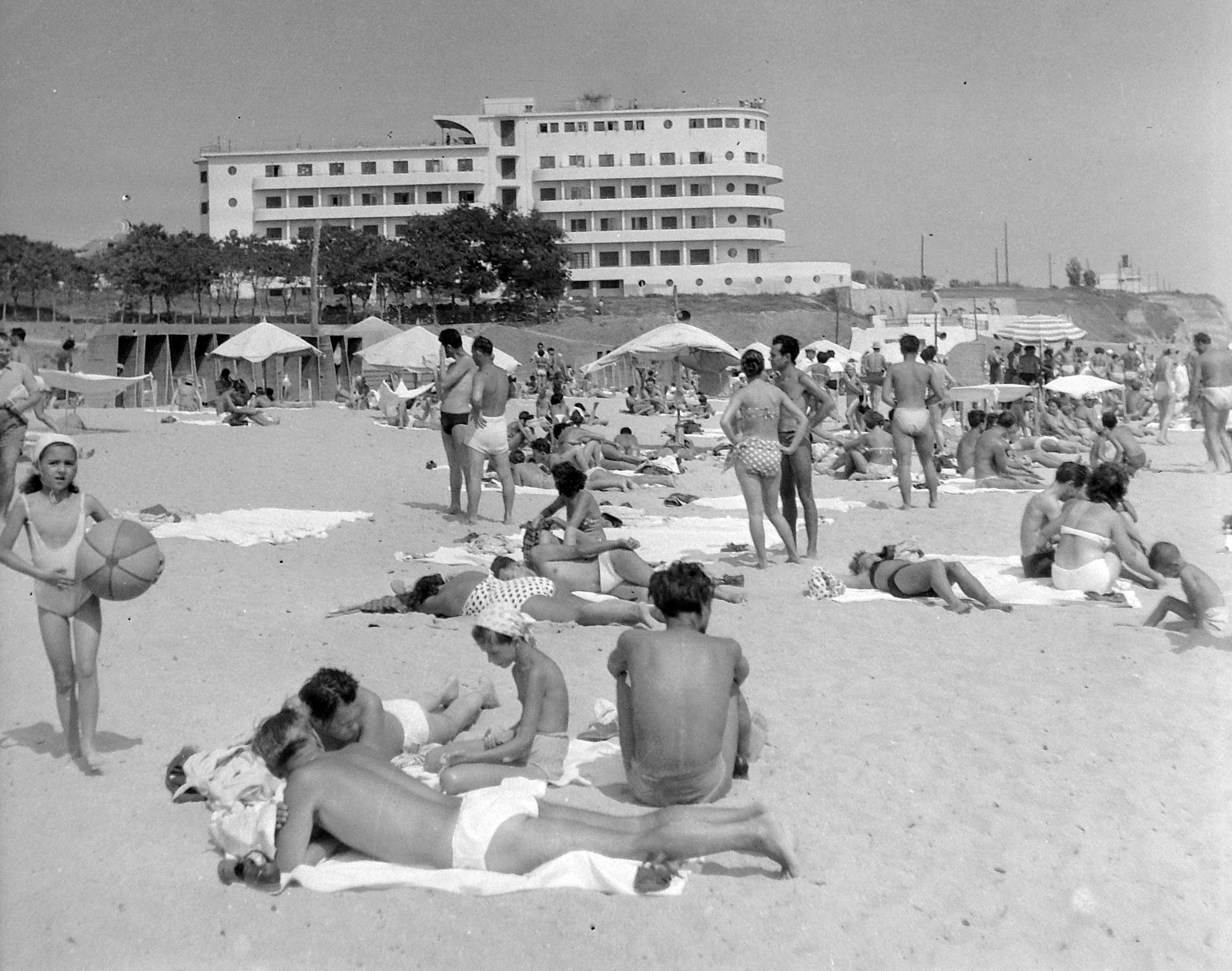
Eforie Nord would not exist without Lake Techirghiol. The resort appeared at the end of the 19th century precisely because of the lake’s mud and salt water, and the sea came, as an attraction, only in second place. Today, most tourists come for the beach and discover the lake by chance, even though it is a few minutes’ walk away. This guide explains what Techirghiol mud is, how the cold baths work, what to watch out for and what else you can see on the lakeshore.
Contents
The lake in brief
- Where it is: between Eforie Nord, Eforie Sud and the town of Techirghiol, separated from the Black Sea only by a narrow strip of sand, which carries the road and the railway.
- How big it is: it covers around 11–12 square kilometres and extends far into the interior of Dobruja, in several arms.
- How salty it is: the water on the sea side is several times saltier than the Black Sea. Towards the west, beyond the dykes, the lake becomes brackish and then fresh.
- What is special about it: the sapropelic mud on its bed, black, fine and greasy, used for spa purposes for over a century.
- Its status: it is a wetland of international importance (a Ramsar site) and a protected area for birds.
The legend of Tekir
The name of the lake comes from the Turkish language. The most widespread explanation links it to an old man named Tekir. The story goes that Tekir, lame and almost blind, arrived one day on the shore of the lake with his donkey, old and covered in sores. The donkey walked into the mire and would not come out, however hard the old man pulled. Tekir stayed for hours in the mud, beside the animal. When they finally came out, the donkey’s sores had closed, and the old man felt that his legs obeyed him again.
It is a legend, not a medical record, but it says something true: the local people noticed the effects of the mud long before doctors studied them. In the town of Techirghiol, a statue depicts Tekir and his donkey.
What sapropelic mud is
Techirghiol mud forms very slowly, on the bed of the lake, from the decomposition of plants and tiny organisms that live in the salt water, in the absence of oxygen. The result is a black, glossy paste with a distinctive smell, rich in mineral and organic substances. It spreads easily on the skin and keeps its heat for a long time, a property on which the warm mud baths in the sanatoria are based.
Together with the lake’s very salty water and the summer sun, the mud is the basis of what doctors call the Techirghiol spa cure. For over a hundred years it has been recommended in particular for disorders of the locomotor system, as well as for some skin problems. Only a doctor can determine what suits you.
The cold baths: the traditional method
The “băi reci” (cold baths) are the old, simple way of taking the cure, in the open air, in summer. There is nothing cold about them apart from the name: they are called that in contrast to the warm mud baths, taken in a tub, in the sanatorium. In Eforie Nord, the cold baths are on the lakeshore, a short distance from the centre of the resort.
How it is done, step by step
- You warm up in the sun for a few minutes, so that your skin is warm.
- You coat yourself in mud all over or only on the areas that concern you, in a thin layer. You avoid the face, the eyes and the heart area.
- You stay in the sun, standing or walking about, until the mud dries and lightens in colour. It usually takes between 15 and 30 minutes.
- You go into the lake and rinse off. The water is so salty that you float effortlessly.
- You take a shower with fresh water and rest in the shade for at least half an hour.
Traditionally, the cure is taken in courses of several days in a row, in the morning, when the sun is gentle. The afternoon is left for the sea or for rest.

What to watch out for
The mud and the salt water have real effects on the body, and that is precisely why they are not suitable for everyone, at any time.
- Ask your doctor first if you have a heart condition, high blood pressure, an acute illness, a fever, a skin disease, or if you are pregnant. The same recommendation applies to small children.
- Do not overdo the duration. In the first days, stay in the sun for a short time with the mud on your skin and see how you react.
- Protect your eyes. The lake water stings very badly. Do not dive in and do not rub your eyes with salty hands.
- Do not go in with open wounds or straight after waxing or shaving: the salt will make them unforgettable.
- Drink water. The sun, the salt and the mud dehydrate you.
- Take an old swimsuit. The mud stains light-coloured fabrics.
Cold baths or sanatorium treatment?
The two do not exclude each other, but they are different things.
- The cold baths are an open-air summer experience that you can try on one morning, without an appointment. They are open in the warm season.
- Spa treatment takes place under medical supervision, in treatment centres. It includes warm mud baths, wraps, salt-water baths with water from the lake, physiotherapy and other procedures, determined after a consultation. In the town of Techirghiol there is a spa sanatorium known throughout the country, open all year round, and in Eforie Nord there are treatment centres in several hotels.
If you are coming for a health problem, choose treatment on a doctor’s recommendation. If you are just curious, one morning at the cold baths is enough to understand why people have been coming here for over a century.
From sanatorium to resort
The history of Eforie begins with the lake. In 1894, Eforia Spitalelor Civile din București (the board of Bucharest’s civil hospitals) bought a plot of land on the strip between the lake and the sea, and in 1899 it opened its seaside sanatorium here. Around it grew the resort that bears its name.
It is no coincidence that the building that houses Hotel Belona today was also built as a sanatorium: the Society of Disabled War Veterans laid its foundation stone on 22 October 1932 and inaugurated it in August 1933, to care for those wounded in the First World War. Only from 1934 did it become a hotel. The story, with period photographs, is on the page The history of the place, and the history of the whole resort in the article from the Eforie sanatorium to today’s resort.

What else you can see on the lakeshore
The birds
Techirghiol is one of the best places in Dobruja for birdwatching. The lake has been declared a wetland of international importance, and in late autumn and winter it gathers large flocks of geese and wild ducks arriving from the north. Among them is the red-breasted goose, a rare species, globally threatened. In summer you can see gulls, terns, black-winged stilts and egrets. A pair of binoculars and a little patience are all you need.
The monastery in Techirghiol
In the town of Techirghiol, a few kilometres from Eforie Nord, stands the “Saint Mary” Monastery. In its grounds is an old wooden church, brought from Transylvania and set up here in 1951. The place is quiet, with flowers and a view of the lake, and is linked to the name of Father Arsenie Papacioc, who served here for decades.
The sunset
The coast faces east, so the sun does not set into the sea. It sets, instead, over the lake. From the shore of Techirghiol, the summer sunset is red, wide and almost always peaceful. It is the right counterpart to the sunrise seen in the morning from the seafront.
The road between the waters
Between Eforie Nord and Eforie Sud, the road runs along the spit of sand that separates the lake from the sea. On some stretches you see both waters at once: the sea, blue and restless, on the left, and the lake, motionless, on the right. It is a beautiful route for cycling or running, early in the morning.
A day between the lake and the sea
- Morning, 8:30–11:00: the cold baths. Mud, sun, a dip in the lake, a shower.
- Lunch and rest: in the shade, with plenty of water. After the mud, the body asks for a break.
- Afternoon, from 16:30: the beach by the sea. The contrast between the heavy lake water and the waves of the sea is felt at once.
- Evening: the sunset over the lake, then a walk along the seafront.
If you are staying at Hotel Belona, the sea is two to three minutes away, by the steps, and the lake is a short walk through the resort. Breakfast is included, so you can set off for the cold baths while it is still cool. You will find more ideas for your stay in the guide things to do in Eforie Nord.
The lake out of season
In autumn and winter, when the cold baths are closed, Techirghiol remains a good place for a walk. The shore is quiet, the light is low, and flocks of birds from the north gather on the water. On frosty mornings, the salt forms a white stripe along the shore, and steam rises from the water. Take binoculars, warm clothes against the wind and keep your distance from the birds so as not to frighten them: in winter, every unnecessary flight costs them precious energy.
How the lake was formed
Techirghiol is what geographers call a maritime liman (lagoon). A long time ago, there was a bay of the sea here, into which a valley emptied. Gradually, waves and currents brought sand and raised a bar that closed off the bay, separating it from the sea. Left without a connection to the sea and fed too little by springs and rain, the water evaporated summer after summer, and the salts became concentrated. This explains why a lake a few hundred metres from the sea is several times saltier than it.
The sand bar is the very strip along which the road and the railway between Eforie Nord and Eforie Sud run today. When you travel along it, you have the sea on one side and its former bay on the other.
In the 20th century, irrigation in the surrounding area brought a great deal of fresh water into the lake, and the salinity dropped. To protect the part with the mud, the lake was divided by dykes into three zones: a salty one, on the sea side, a brackish one, in the middle, and a freshwater one, towards the interior. For this reason, Techirghiol today shelters very different creatures, from those of salt water to freshwater fish.
Myths and truths about the mud
- “The longer you stay, the better.” False. The duration is increased gradually, and excess tires the body.
- “Mud is good for everything.” False. It has precise indications and contraindications, which a doctor determines.
- “You can take mud home from the lake.” Therapeutic mud is a protected resource, and its extraction is regulated. There are packaged products, sold legally.
- “Cold baths are cold.” False. They are taken in summer, in the sun; the name distinguishes them from the warm baths in the sanatorium.
- “The lake water is dirty.” The dark colour and the smell come from the mud and the salts, not from dirt.
What to take with you to the cold baths
- an old, dark-coloured swimsuit;
- flip-flops, because the lakeshore is hard and salty;
- a towel you won’t mind getting stained;
- a hat and sunglasses;
- drinking water, at least a litre;
- a bottle of fresh water, for rinsing your face and hands;
- a moisturising cream for after the shower, because salt dries the skin.
Frequently asked questions
Can you swim in Lake Techirghiol?
Yes, in the designated areas. The dip in the lake is part of the traditional cure: you rinse off the mud in the salt water. It is not a lake for sport swimming; you float rather than swim, and the water must not get into your eyes.
Why do you float in Lake Techirghiol?
Because the water is very salty, and therefore denser than ordinary water. The body is pushed upwards harder than in the sea or in a freshwater lake.
When are the cold baths in Eforie Nord open?
In the warm season, usually from June to September, depending on the weather. The exact schedule changes from year to year, so it is worth checking on the spot at the start of your stay.
How many days does a mud cure last?
Spa cures prescribed by doctors usually run for one to three weeks. For anyone who just wants to try it, a few mornings at the cold baths are enough.
Does the mud smell bad?
It has a distinctive smell, of sulphur and a salty pond, which some people find unpleasant in the first minutes. After rinsing in the lake and showering, the smell disappears.
Can children go to the mud baths?
Only with the paediatrician’s approval and for short periods. Children’s skin is sensitive, and salt water can irritate their eyes very easily.
How far is the lake from the beach?
The resort sits on a narrow strip of land, so between the sea and the lake there are only a few hundred metres. You can walk there in a few minutes.
The period photographs on this site come, for the most part, from the Andrei Ștomff Collection of the National Institute of Heritage and from the Fortepan archive; the source and licence of each image are given in its caption.