

The history of Eforie Nord begins with a salt lake and a charitable institution.
Eforie Nord has a strange name for a seaside resort. It does not come from a village, a saint or a boyar, but from an institution: Eforia Spitalelor Civile (the board of Bucharest’s civil hospitals). The name tells you from the start what the place was made for: health. The story of the resort, from the first sanatorium to today’s seafront, spans more than 125 years and can still be read on its buildings. We tell it briefly below, in chronological order, with the help of old photographs and postcards.
Contents
The history of the Eforie Nord resort in a few dates
- 1894: Eforia Spitalelor Civile buys a plot of land between Lake Techirghiol and the sea.
- 1899: the Eforia seaside sanatorium opens. The resort grows around it.
- 1930–1934: the seafront is divided into plots according to a plan by the architect George Matei Cantacuzino.
- 22 October 1932: the foundation stone of the future Hotel Bellona is laid.
- August 1933: the building is inaugurated, as a seaside sanatorium.
- 1934: the sanatorium becomes a hotel; an architecture magazine in Paris publishes its plan.
- 1948: nationalisation. Villas and hotels become rest houses.
- The 1960s and 1970s: the resort’s big hotels are built.
- 2020–2021: the beaches are widened by sand replenishment.
Before the resort: a salt lake and a legend
At the end of the nineteenth century, there was almost nothing on the strip of land between Lake Techirghiol and the sea. Dobruja had joined Romania’s borders only in 1878, and the shore south of Constanța was deserted, with a few villages of shepherds and fishermen. What did exist, however, since time immemorial, was the lake, with its heavy, salty water and the black mud on its bed.
The locals knew its powers. The legend says that an old lame man, Tekir, and his donkey, covered in sores, were healed after being stuck for a whole day in the mud of the lake. The name would also come from him: Techirghiol, “Tekir’s lake”. I told the legend and described how the mud is used in the Lake Techirghiol guide.
1894–1899: Eforia builds a sanatorium
Eforia Spitalelor Civile was the institution that administered the big hospitals of Bucharest and one of the wealthiest charitable foundations in the country. Its doctors were looking for a place where patients, especially children and those with bone and joint diseases, could be treated with sun, sea air and mud.
In 1894, Eforia bought a plot of land on the strip between the lake and the sea. Its seaside sanatorium opened in 1899. Around it there gradually appeared villas, guesthouses and shops, and the growing settlement was named, naturally, after its founder: Eforia, then Techirghiol-Eforia and, finally, Eforie.
A few kilometres to the south, on the other side of the sand spit, a second resort was born in the same years, founded by a landowner, Ioan Movilă. It was called, in turn, Techirghiol-Movilă, Carmen Sylva, after Queen Elisabeth’s pen name, and, after a period in which it bore a name imposed by the communist regime, Eforie Sud.
The 1930s: the modernist seafront
The big change came after 1930. The land on the seafront, owned by the banker Aristide Blank, was divided into plots between 1930 and 1934 according to a plan by the architect George Matei Cantacuzino. The plots were bought by well-off people from Bucharest, and their villas were designed by architects who would enter the history of Romanian architecture: Cantacuzino himself, Horia Creangă and Henrieta Delavrancea-Gibory.
The result is a rare ensemble: an entire seafront built in a few years, in the same spirit. White volumes, roof terraces, long balconies, round windows. It was the newest architecture of the day, and by the sea it was a perfect fit: it looked like ships.

In 1934, the Paris magazine L’Architecture d’aujourd’hui noted that at Eforie a single architect had been able to build an entire beach: a few villas and a hotel. I wrote about this chapter at length in the article modernist architecture on the coast.
1932–1934: the ship on the seafront
At the southern end of the seafront, the Society of Disabled War Veterans, led by Major M. Văgăunescu, decided to build a seaside sanatorium for those wounded in the First World War. The foundation stone was laid on Saturday, 22 October 1932. The plans were by Cantacuzino, who placed the building perpendicular to the shore, with the rounded end towards the sea, like the prow of a ship.
In August 1933, the building was inaugurated. It was named after Bellona, the Roman goddess of war, protector of those wounded in battle, as was explained at the inauguration, according to the newspaper Universul.
The sanatorium did not remain a sanatorium for long. In March 1934 tenders were invited for leasing the building and the restaurant, and a month later the Bucharest hotel company SARPEH decided to open a branch here. In the summer of that year, advertisements invited readers to “Hotel Bellona”, at Eforia.

1934–1940: the fashionable resort
In the second half of the 1930s, Eforia was one of the elegant addresses on the coast. The Enciclopedia României (Encyclopaedia of Romania), in the volume published in 1938, names two luxury hotels here: Bellona and Neptun. Newspapers describe their terraces and lobbies as the resort’s meeting places.
Among those who passed through were politicians of the day. The newspaper Dimineața of 19 June 1935 recorded, for example, a tea given by Nicolae Titulescu and his wife on the terrace of the Bellona hotel. I wrote about it in the article Titulescu’s tea on the Bellona terrace.
In July 1937, a newspaper described the hotel as a huge four-storey ship, which plunges its prow, a concrete terrace, straight into the sea. A year later, Neamul Românesc wrote about “the Bellona hotel with its specifically marine architecture”.
1940–1948: war and nationalisation
The war did not close the resort all at once. In July 1940, advertisements announced that the Neptun and Bellona hotels were open and operating normally. A year later, the invalids’ society was offering its seaside sanatoriums for the care of the wounded from the front.
After the war came the change of regime. In 1948, properties were nationalised. The villas on the seafront lost their owners, and the hotels lost their names. The architect George Matei Cantacuzino was imprisoned between 1948 and 1954 and died in 1960.
The 1950s: rest houses
In the first communist decade, Eforie became a resort for “working people”. The pre-war villas and hotels were turned into rest houses and sanatoriums, where people came with a voucher through their trade union.
The postcards of the time show the change better than any document. On a postcard mailed on 5 August 1955, the former Bellona hotel appears with a slogan of the People’s Republic on the roof and the title “Eforie – Sanatoriul” [Eforie – The Sanatorium]. On another, from 18 August 1957, it is called the “Marea Neagră” (Black Sea) rest house. People had not forgotten the old name, however: in 1958, the magazine Arhitectura spoke of “the former Belona hotel”.

The 1960s and 1970s: the big hotels
Starting in the 1960s, the state invested heavily in coastal tourism. In Eforie Nord, new, tall hotels went up, with hundreds of rooms, large restaurants and treatment centres. The resort stretched northwards and inland, and the number of tourists grew from year to year. At the same time, Eforie Nord and Eforie Sud were merged administratively into the town of Eforie.
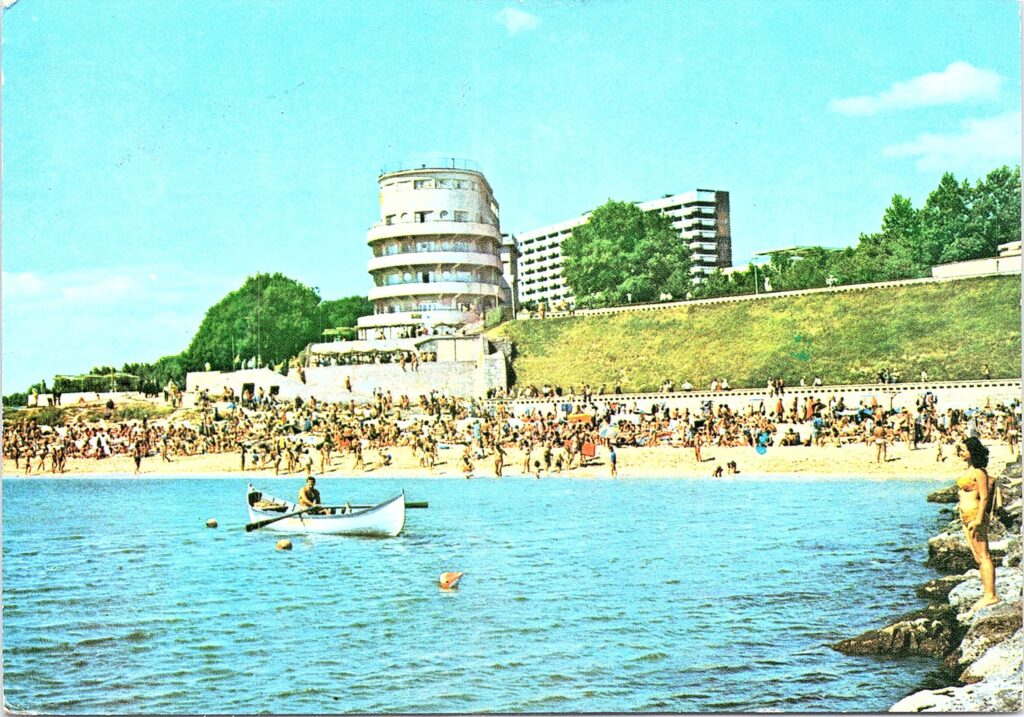
The colour postcards of those years show the beach full of umbrellas and, behind the old white villas, the silhouettes of the new hotels. It is also at this time that the name returns to the building at the end of the seafront: “Vila Belona” on a postcard from 1969, “Hotel Belona” on one from 1976, by now with a single l. The story of the name is in the article Bellona with two l’s.
After 1990
The years after 1989 brought the privatisation of the hotels, new villas and guesthouses, but also a long period in which many old buildings were left to decay or were altered carelessly. In recent years, interest in the interwar architecture of the seafront has grown. The National Institute of Heritage documented it in the project “Boemă și Loisir”, in 2022, and some of the buildings are now protected as historic monuments.
Between 2020 and 2021, the beaches of Eforie Nord were widened by sand replenishment, in a project to protect the shore against erosion. The strip of sand is now much wider than the one in the old photographs.
What can still be seen today of the resort’s history
- The seafront. The route of the promenade and the division into plots from the 1930s are, broadly, those conceived by Cantacuzino.
- The modernist villas. Some are restored, others are waiting. You recognise them by their simple, white volumes, with terraces and round windows.
- Hotel Belona. It is a Grade A historic monument, the category of monuments of national value, entered in the List of Historic Monuments under the code CT-II-m-A-02880. Its ship shape is unchanged.
- The cold baths. The open-air mud cure on the lakeshore is carried out today almost the same way as a hundred years ago.
- The name. “Eforie” preserves the memory of the institution that founded the place.

How to see the history with your own eyes
- Start at the lake. That is where it all began. A morning at the cold baths shows you why Eforia came here.
- Cross the resort towards the sea. It is only a few hundred metres, exactly the width of the strip of land on which it was built.
- Walk along the seafront, heading south. Look at the old villas and look for the round windows and terraces.
- Stop at the end, at the ship. Go down the steps to the beach and look back: it is the view from the 1958 postcard.
- Go up on the terrace for a coffee. It is the terrace from the newspaper report of June 1935.
All the photographs and postcards we have talked about, in chronological order, are on the page The history of the place. If you want to sleep in a chapter of this story, Hotel Belona welcomes guests on the same seafront, with breakfast included and the beach two to three minutes away. Reservations on +40 21 555 25 70 or at belona@avenuehotels.ro.
The resort in postcards
Much of what we know about how Eforie looked comes from postcards. For decades, the postcard was the usual way of saying “we arrived safely, the weather is lovely”, and publishers’ photographers captured, season after season, the same places: the beach, the seafront, the hotels.
The National Institute of Heritage keeps, in the Andrei Ștomff Collection, dozens of postcards of the building at the end of the seafront. Put in order, they show three things that no chronicle states as clearly:
- How the name changed. “Eforie – Sanatoriul” in 1955, the “Marea Neagră” rest house in 1957, “Vila Belona” in 1969, “Hotel Belona” in 1976.
- How the beach filled up. From a few people on the sand, in the black-and-white images, to the sea of umbrellas in the colour postcards of the 1970s.
- How the resort grew. Behind the white villas there appear, from one decade to the next, the silhouettes of the new hotels.
A detail for the attentive: the year written under each image is that of mailing, read from the postmark. The photograph could be a year or two older, because publishers reprinted the same plates for several seasons in a row.
The people who made Eforia
- The doctors of Eforia Spitalelor Civile, who chose the place for its sun, air and mud and opened the sanatorium in 1899.
- Aristide Blank, the banker who owned the land on the seafront and who divided it into plots between 1930 and 1934.
- George Matei Cantacuzino, the architect who drew the division into plots and the ship-shaped hotel.
- Horia Creangă and Henrieta Delavrancea-Gibory, the architects who built villas on the seafront.
- Major M. Văgăunescu and the Society of Disabled War Veterans, who built the “Bellona” sanatorium.
- The photographers and postcard publishers, most of them anonymous, thanks to whom we know how it all looked.
What we do not yet know
The history of the resort also has gaps, and it is only honest to name them. The sources do not agree on the years in which the buildings on the seafront were renovated, and for many of the interwar villas it is no longer known for whom they were built. Interior photographs from the 1930s are rare. If you have at home an old postcard of Eforie or a family photograph taken on the seafront, it could complete the story.
Frequently asked questions
Why is it called Eforie?
After Eforia Spitalelor Civile of Bucharest, the institution that bought the land in 1894 and opened its seaside sanatorium here in 1899.
When was the resort of Eforie Nord founded?
The starting year is considered to be 1899, when the Eforia sanatorium opened. The land had been bought in 1894.
Which is the oldest resort on the Romanian coast?
Eforie Nord is among the oldest, alongside Techirghiol, Eforie Sud and Mamaia, all of which appeared around 1900.
Who designed the seafront in Eforie Nord?
The division of the seafront into plots, in 1930–1934, was made according to a plan by the architect George Matei Cantacuzino. The villas were designed by him, by Horia Creangă and by Henrieta Delavrancea-Gibory.
What historic monuments are there in Eforie Nord?
The best known is Hotel Belona, a Grade A monument, inaugurated in 1933. Modernist villas from the same period also survive on the seafront.
What was Eforie Sud called before?
Techirghiol-Movilă, then Carmen Sylva, Queen Elisabeth’s pen name. In the first years of the communist regime it bore another name, and since the 1960s it has been called Eforie Sud.
How do we know all this?
From the press of the time (Universul, Dimineața, Epoca, Neamul Românesc), from the studies of the National Institute of Heritage and of the architect Ruxandra Nemțeanu, and from the postcards of the Andrei Ștomff Collection, held at the National Institute of Heritage.
The vintage photographs on this site come, for the most part, from the Andrei Ștomff Collection of the National Institute of Heritage and from the Fortepan archive; the source and licence of each image are given in its caption.